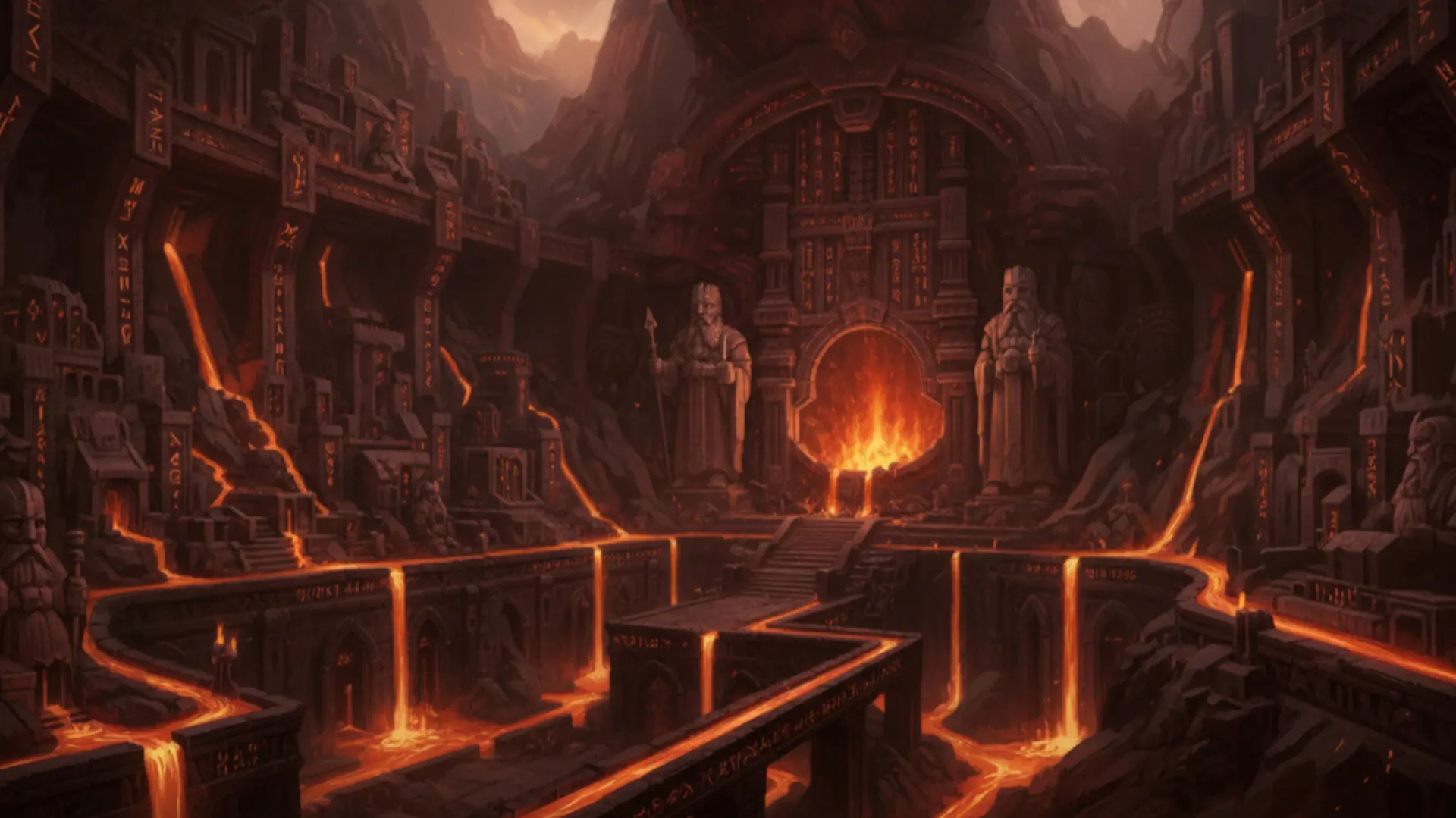
Khazad-Karn
The Mountain Fortress
Dwarf CityThe City of Khazad-Karn
Deep within the Ironpeak Mountains lies Khazad-Karn, the greatest of the dwarven holds. Its halls stretch for miles, carved with geometric precision from the living stone. The air is warm from the never-sleeping forges, and the constant ring of hammers on anvils serves as the city's heartbeat.
The dwarves have mined these mountains since before human memory, extracting precious metals and gems that made their kingdom wealthy beyond measure. But their picks dug too deep, and in their greed, they broke through into something that should have remained buried forever.
History
Khazad-Karn was founded by Durin Ironbeard, who led his people into the mountains seeking shelter from the chaos that engulfed the surface world. They found more than shelter—they found veins of gold and silver, deposits of mithril, and caverns glittering with gems.
For centuries, the dwarves expanded their mines ever deeper, following the richest veins of ore. The wealth they extracted built their kingdom into a power that rivaled any surface nation. Their craftsmanship became legendary, and kings from across the world sought dwarven-made weapons and armor.
Then came the Breach.
No one speaks of what the miners found when their picks broke through the final layer of stone. The records from that day have been destroyed, and the survivors refused to speak of it until their dying breaths. What is known is that the corruption spread up through the tunnels like a tide, and the dwarves were forced to seal off the lower levels of their own city.
Districts
The Great Hall
A massive cavern serves as the heart of Khazad-Karn, where dwarven runes glow with inner fire on every surface. The never-sleeping forges burn day and night, and the sound of hammers on anvils never ceases. This is where the clans gather for celebrations and councils.
The Gate House
The entrance to Khazad-Karn is guarded by massive iron doors three feet thick. Murder holes line the approach, and the stone itself is scarred from ancient battles. The dwarves have never needed to use these defenses against outside invaders—their enemies come from below.
The Hall of Ancestors
The most sacred place in the kingdom, where stone effigies of every dwarven king stand in eternal vigil. An altar of polished granite serves as the focus for ancestral rites, and the walls are carved with ten thousand names—every dwarf who has died defending the hold.
The Great Forge
A massive forge that has burned for a thousand years, fed by rivers of molten metal channeled through stone. Here, the master smiths create weapons and armor of legendary quality, blessed against the corruption that lurks below. The heat rivals any natural fire.
The Breach
The sealed entrance to the endless depths below. Corrupted stone twists into unnatural formations, and strange whispers echo from behind the barriers. Rough-hewn stairs descend into absolute darkness—stairs that were once the main mining shaft, now sealed with every ward and blessing the dwarves know.
Culture
Dwarves value tradition above all else. They honor their ancestors, maintain their ancient customs, and hold grudges that span generations. Their clan structure defines every aspect of life, from who they marry to what trades they may practice.
The Breach has shaken this ancient society to its foundations. The oldest traditions offer no guidance for fighting an enemy that corrupts from within. Young dwarves question whether the old ways are still relevant, while the elders insist that only by holding to tradition can they survive.
The Depths
The Descending Mines now serve as both resource and battlefield. The upper levels are still worked, though with heavy guard—the ore there remains untainted, and the kingdom needs the wealth to fund its defenses. But below a certain point, no dwarf ventures alone.
The corruption manifests differently in the mines than elsewhere. Stone itself becomes malleable, forming faces that watch from the walls. Veins of precious metal transform into something that looks like gold but burns to the touch. And in the deepest shafts, something moves—something massive, something patient.
"We dug too deep. We always dig too deep." — Last words of Master Miner Thorgrim