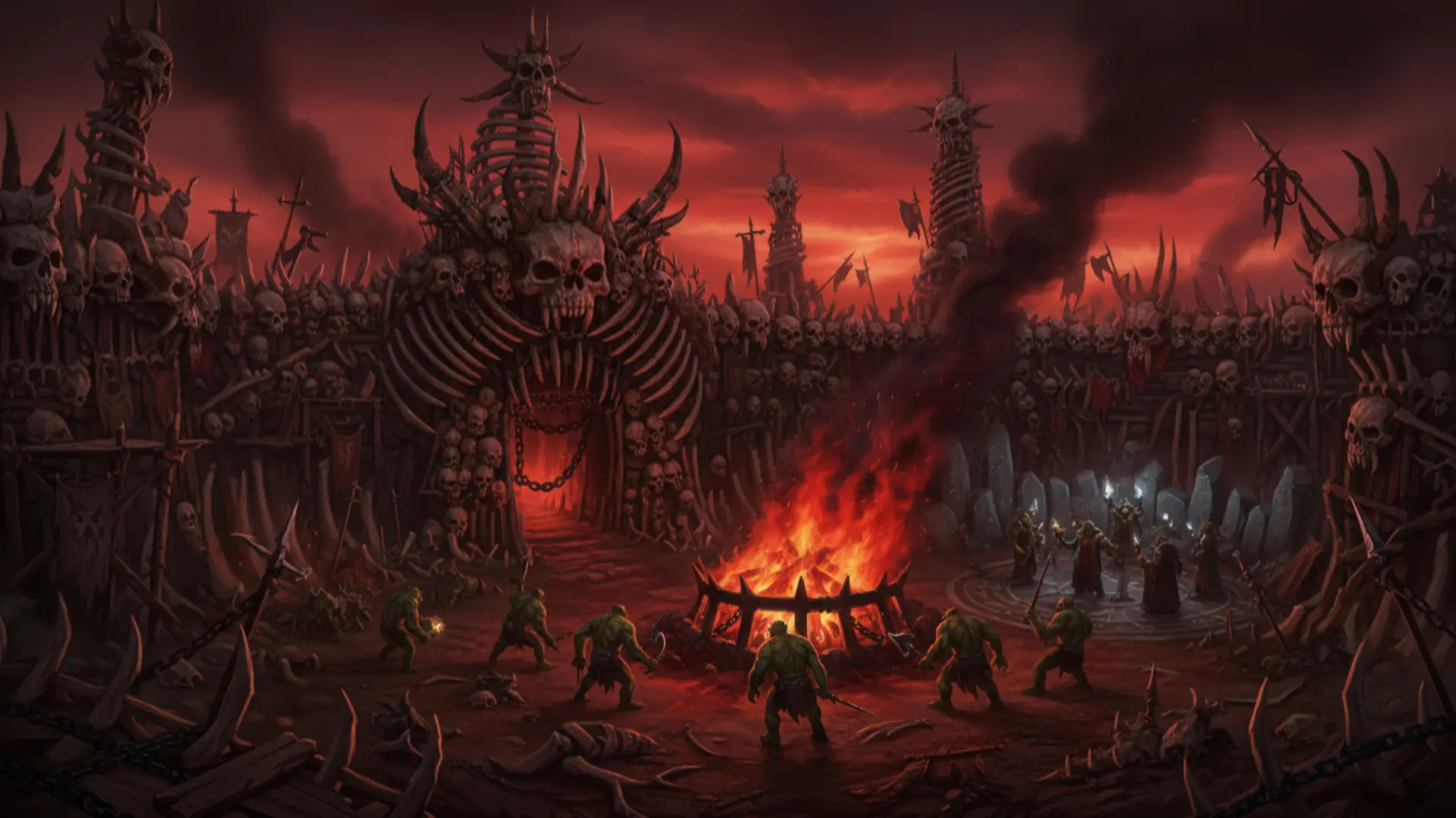
Skullgar
The Eternal Battlefield
Orc CityThe City of Skullgar
Skullgar is not a city in any civilized sense. It is a fortress built for war, expanded through conquest, and decorated with the trophies of a thousand battles. Walls of stacked skulls surround the central encampment, and the gates are formed from the ribcages of great beasts. The air reeks of blood and smoke, and the sound of combat—whether training or real—never truly ceases.
The orcs who dwell here live for battle. They believe that only through combat can one's spirit be forged strong enough to enter the eternal war that awaits after death. Every warrior dreams of dying gloriously, weapon in hand, earning their place among the ancestors.
Now the ancestors have returned, and they are not pleased.
History
Skullgar stands on the site of the First Battle—a conflict so ancient that even the orcs have forgotten who they fought or why. What they remember is that they won, and that their ancestors' spirits blessed the ground with their sacrifice. The orcs built their fortress here, believing that the spirits of the fallen would strengthen living warriors.
For centuries, this seemed true. Orc warriors who trained at Skullgar became legendary for their ferocity and endurance. Shamans could commune with ancestral spirits, gaining wisdom and power. The ground itself seemed to feed the orcish war machine.
Then came the Night of Rising.
The dead crawled from the earth. Not just orcs—every creature that had ever died on this blood-soaked ground rose to fight again. And unlike the peaceful ancestor spirits the shamans had known, these dead were filled with rage. They attacked the living without discrimination, and when they were cut down, they simply rose again.
The orcs, for the first time in their history, were forced to fight a defensive war. And they discovered, to their horror, that they could not win.
Districts
The War Pit
The central gathering place of Skullgar, where orcs come to fight, boast, and settle disputes through combat. A massive iron fire pit burns day and night, and the bones of defeated enemies line the arena floor. A travel portal churns in the center—the orcs have little patience for walking when there's fighting to be done.
The Bone Gate
The entrance to the Beast-Skull Tower, formed from the skull of a creature so massive that twenty orcs could walk through its eye socket. Corrupted energy pulses through the ancient bone, and the jaw seems to twitch as if preparing to bite down on anyone who enters.
The Training Grounds
Where young orcs learn to fight under the brutal tutelage of veteran warriors. No quarter is given in training—the orcs believe that easy lessons make weak warriors. The wounded are expected to fight through their injuries, and those who fall are left where they lie until they can rise on their own.
The Shaman's Circle
A ring of standing stones where the shamans conduct their rituals. These orcs serve as the spiritual guides of their people, communing with ancestors and interpreting omens. Since the Rising, their role has become more desperate—they spend their days trying to understand why the dead have turned against them.
The Trophy Hall
A massive bone structure where the most valued war trophies are displayed. The skulls of mighty beasts, the weapons of defeated champions, the banners of conquered tribes—all hang here as testament to orcish might. Recently, some of these trophies have begun to move on their own.
Culture
Orcish society is brutally simple: the strong rule, the weak serve, and everyone fights. Status is earned through combat, lost through defeat, and maintained through constant vigilance. There is no concept of retirement—orcs fight until they die, and those who can no longer fight become shamed outcasts.
This worldview has made the current crisis particularly challenging. The dead cannot be truly defeated—they rise again and again, no matter how many times they are cut down. For a culture built entirely around victory in combat, fighting an enemy that cannot be beaten threatens their very identity.
Some orcs have responded by fighting harder, believing that sufficient ferocity must eventually triumph. Others have begun to question whether the old ways can survive this new kind of war. A few have even suggested the unthinkable: perhaps the orcs need allies.
The Rising
The Beast-Skull Tower was once a simple mausoleum, where great orc warriors were laid to rest with their weapons. The tower grew over centuries as more heroes joined their ancestors, their bones stacked in elaborate patterns that the shamans said would give them peace.
Now those bones have assembled themselves into something new.
The undead that emerge from the tower are not mindless corpses—they remember their lives, their battles, their grudges. They fight with the skill they possessed in life, augmented by the tireless strength of death. And they are angry.
The shamans believe they know why. The ancestors were promised eternal war in the afterlife—glorious combat that would never end. Instead, they found themselves trapped, unable to move on, forced to watch as generation after generation of orcs died and joined them in imprisonment. The Rising is not an attack. It is a prison break.
And the living orcs are standing between the dead and their freedom.
"I killed my father three times yesterday. He still hasn't forgiven me for losing his sword." — Warchief Groktar, at the morning war council