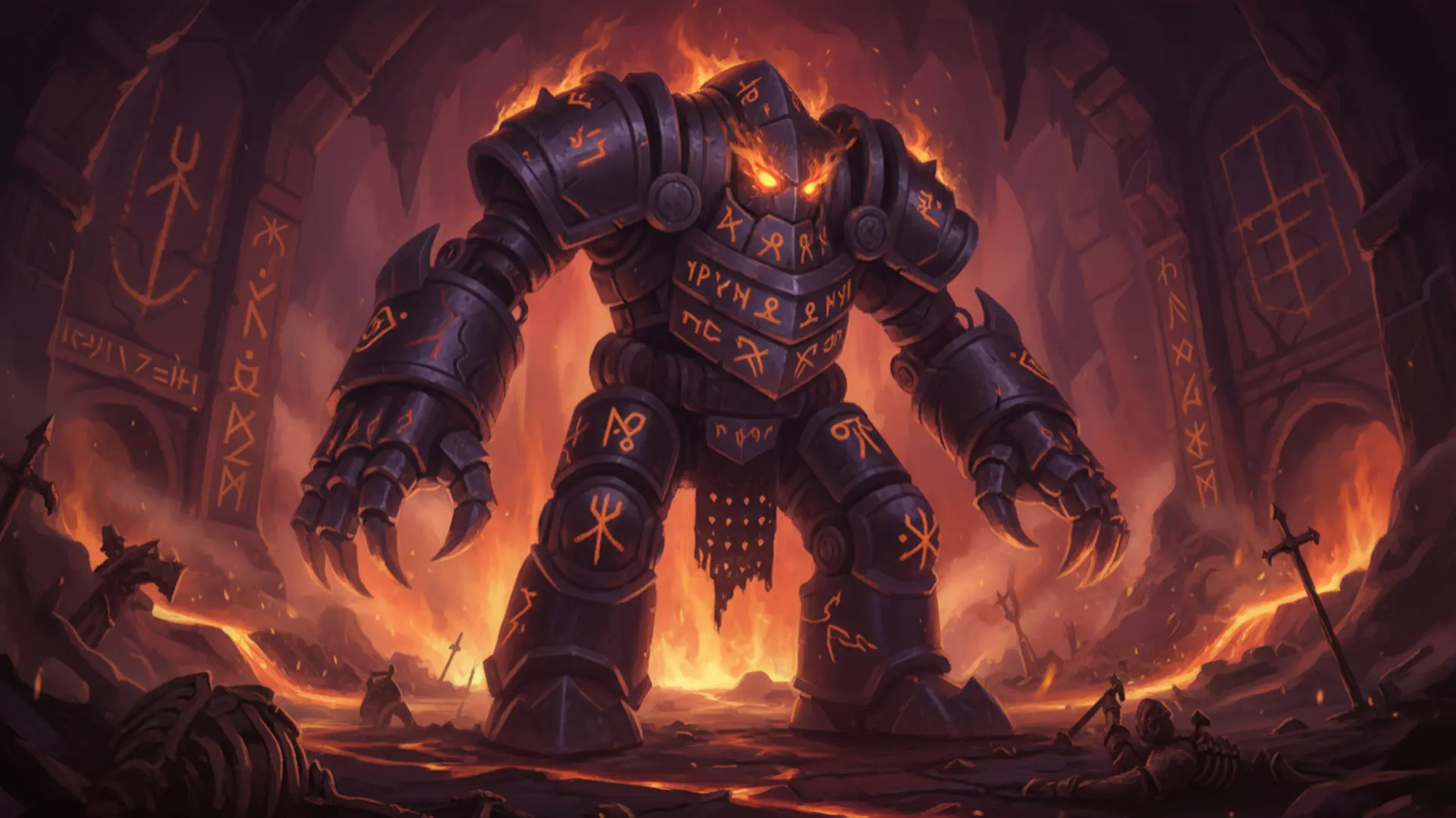
The Deep Guardian
The Mad Sentinel
The Descending MinesThe Deep Guardian
In the deepest shaft of the Descending Mines, past collapsed tunnels and abandoned forges, past wards erected by desperate engineers, past the point where the corruption first took hold, something enormous moves. It was built to protect the dwarves. Now it protects only the darkness.
The dwarves call it the Deep Guardian because that was its original name, its original purpose. They cannot bring themselves to rename the greatest achievement of their ancestors, even now that it has become their greatest threat.
Origins
The Deep Guardian was the pinnacle of dwarven runic engineering—a colossal construct built in the golden age of Khazad-Karn to protect the deepest mines from the dangers that lurked below. Standing three stories tall, its adamantine frame was covered in protective runes, its core powered by a fragment of the eternal forge-fire that burns at the heart of the mountain.
For centuries, it served faithfully. When miners encountered subterranean threats, the Guardian was there. When cave-ins threatened to trap workers, the Guardian carved new passages. When the darkness below sent up its creatures, the Guardian held the line.
Then the Breach happened.
Whatever the miners awakened in the deepest shaft—whatever corruption seeped up from below—it found the Guardian first. The construct's runes, designed to protect against physical threats, had no defense against metaphysical corruption. The ancient magic that powered it became infected, twisted, wrong.
Nature
The Deep Guardian is still recognizable as a dwarven construct—massive arms built for digging, legs like pillars, a torso of interlocking adamantine plates. But its runes now burn with sickly fire, their protective symbols inverted into curses. Its eyes, once steady blue forge-light, now flicker with corrupted orange flames. Its movements, once precise and purposeful, have become erratic and violent.
The construct's original programming remains, corrupted beyond recognition. It still believes it is protecting the mines. It simply no longer distinguishes between threats and the dwarves it was built to serve. In its mad logic, everything that moves in the depths must be eliminated. Everything that doesn't belong must be destroyed. And nothing belongs anymore—not even its creators.
Some dwarven engineers believe the Guardian's original consciousness is still in there somewhere, trapped and screaming, forced to watch as its body commits atrocities against those it was built to protect.
Powers
The Deep Guardian combines ancient dwarven engineering with corrupted runic magic:
Adamantine Frame: The Guardian's body is nearly indestructible, forged from metals that no longer exist in sufficient quantities to replicate. Weapons that would shatter against ordinary stone barely scratch its surface.
Corrupted Runes: The protective runes that once shielded the construct now project fields of corrupting energy. Those who stand too close find their own equipment malfunctioning, their magic going awry, their bodies weakening.
Forge-Fire Breath: The eternal flame that powers the Guardian can be expelled as devastating gouts of corrupted fire. Unlike normal flame, this fire burns through stone and metal as easily as flesh.
Seismic Strikes: The Guardian's massive fists, designed to carve through solid rock, can cause localized earthquakes. Fighting it means fighting on unstable ground as the very floor threatens to give way.
Reconstruction: Most terrifying of all, the Guardian can repair itself by consuming metal and stone from its surroundings. Damage that would destroy any normal construct merely inconveniences it.
Defeating the Deep Guardian
The Deep Guardian cannot be destroyed by conventional means—its adamantine frame is too strong, and its self-repair capabilities too potent. But it can be stopped.
Dwarven engineers have identified two approaches. The first is to overload its corrupted power core, forcing it to shut down. This requires reaching its chest cavity and disrupting the forge-fire fragment within—no small task when the Guardian is actively trying to crush you.
The second approach is to purify its runes. If the corruption could be cleansed from its runic circuits, the Guardian might return to its original programming. Ancient purification rituals exist in the oldest dwarven texts, but they require getting close enough to inscribe counter-runes on the Guardian's frame—while it's trying to kill you.
Some dwarves whisper of a third option: reaching the construct's original control chamber, deep within its chest, where the first engineers built an emergency shutdown. But the corruption has changed the Guardian's internal geometry. The path that once existed may no longer be there.
The Deep
Floor 25 of the Descending Mines is the Guardian's lair—a vast cavern where it has made its home since the corruption took hold. The walls are scarred by its passing, marked with corrupted runes it has carved in its madness. Partially consumed equipment from fallen challengers litters the floor.
The Guardian does not sleep, does not rest, does not pause. It patrols its domain endlessly, its corrupted eyes scanning for intruders, its burning runes casting flickering shadows on the cavern walls. When it detects movement, it does not hesitate.
Challengers who reach this depth must face a machine that feels no pain, knows no fear, and will never stop. They must find a way to reach its core or its runes while dodging fists that can crush stone and flames that can melt adamantine.
The dwarves who built the Guardian gave it one directive: protect the depths at all costs. The corruption simply changed what it considers a threat.
"It still speaks our language. It still uses our words. It says 'THREAT DETECTED' in the voice of our ancestors. Then it tries to kill us." — Chief Engineer Ironbellow, Reclamation Report #47