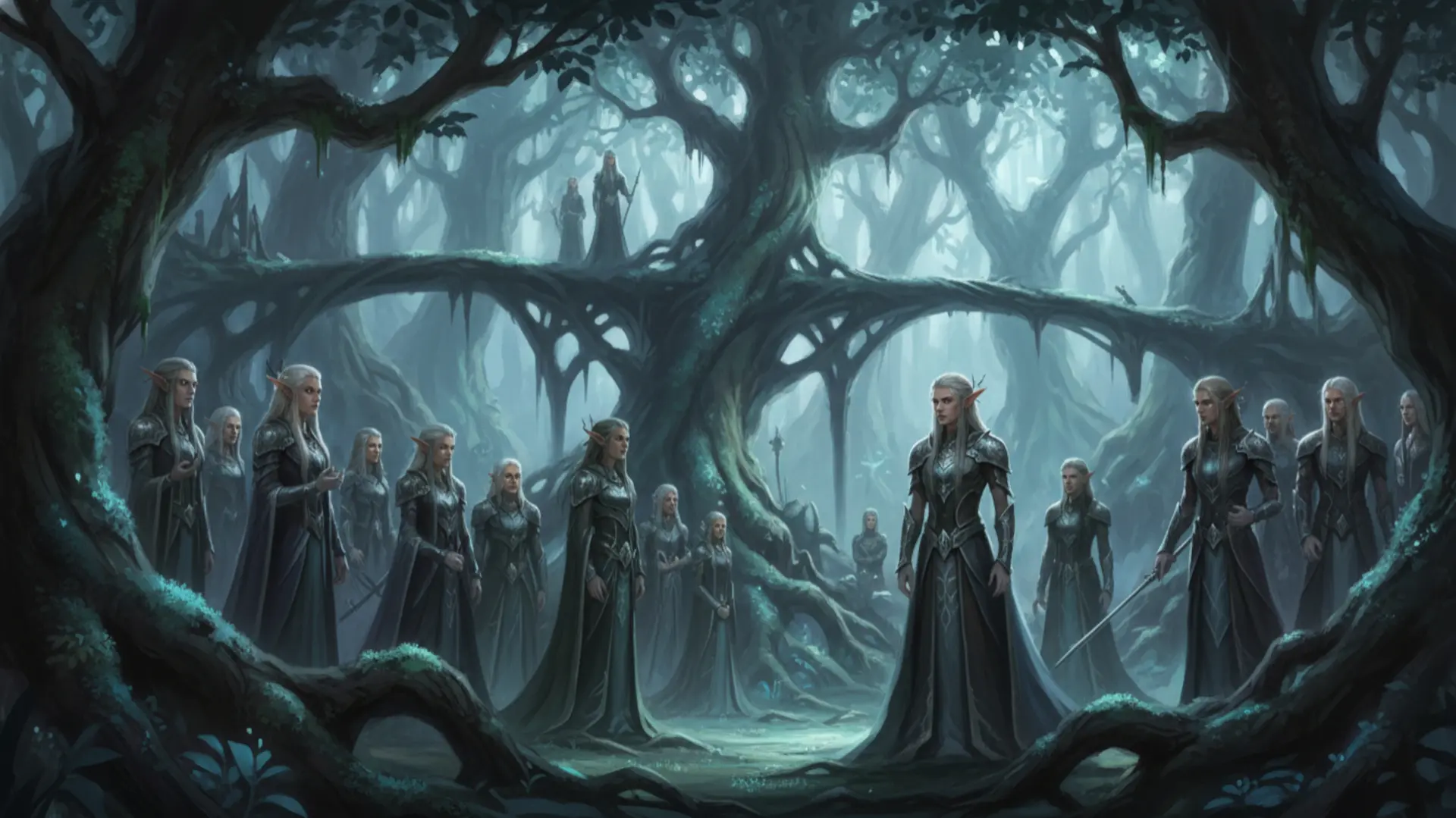
Elves
The Eternal Guardians
The Elven Race
The elves are the eldest of the mortal races, their history stretching back to the dawn of the world itself. They remember when the mountains were young and the seas were shallow. They have watched younger races rise from barbarism to civilization, and they have buried friends who seemed immortal.
Now, for the first time, they face their own mortality.
Origins
Elven mythology holds that the first elves were born from the World Tree itself—spirits of nature given flesh to tend the primordial forests. Whether literal truth or poetic metaphor, the connection between elves and the World Tree is undeniable. Its magic flows through their veins, granting them lives that span millennia.
The earliest elven memories speak of a world without other thinking beings. For countless ages, elves were alone with the trees and the beasts and the slow turning of seasons. They built no cities, for the forest was their home. They kept no histories, for nothing changed enough to record.
Then the other races appeared—dwarves from the mountains, gnomes from the deep places, humans from the plains, orcs from the wastes. The world grew crowded, and the elves were forced to adapt.
Culture
Elven society moves at a pace incomprehensible to shorter-lived races. Decisions that humans would make in days take elves decades to deliberate. Plans unfold over centuries. Grudges last millennia.
This patience stems from their relationship with time itself. When you might live three thousand years, what is the rush? Better to consider all angles, consult all histories, weigh all consequences before acting.
The Councils
Elves govern through councils of elders—those who have lived long enough to gain wisdom. The Elder Council of Sylvanthal includes elves who remember the founding of human kingdoms that have since risen and fallen. Their perspective spans ages.
Yet this ancient wisdom has become a burden. The councils deliberate while the World Tree dies. They seek historical precedent for a situation without precedent. They move at the pace of centuries while the Blight advances daily.
Communion with Nature
Elves do not merely live in the forest—they are part of it. They sense the health of trees as humans sense the health of their own bodies. They hear the whispers of wind and water, the complaints of disturbed earth, the songs of growing things.
This connection makes them exceptional druids and rangers. It also makes the corruption of the World Tree a constant, personal agony. Every elf in Sylvanthal feels the tree's sickness as a shadow on their own soul.
Strengths
Patience: Elves can wait for the perfect moment with a patience that drives other races mad. An elf hunter might stalk prey for weeks. An elf diplomat might spend decades building a relationship before asking a favor.
Memory: What elves witness, they remember perfectly. Their histories require no books—living elves recall events from a thousand years ago as clearly as yesterday. This institutional memory gives them unparalleled context for any situation.
Harmony: Elves move through the natural world without disturbing it. They fight with grace rather than force, build with growth rather than construction. This harmony makes them formidable in their native environments.
Weaknesses
Inflexibility: Elven ways have worked for millennia. Why change? This conservatism makes adaptation difficult when circumstances demand rapid response.
Isolation: Elves often view shorter-lived races as children—well-meaning but ultimately irrelevant. This condescension has cost them allies when allies were needed.
Grief: Elves who bond with shorter-lived beings face inevitable loss. Many respond by withdrawing, refusing to form attachments with those who will die within what feels like moments. This emotional distance has made elves seem cold and uncaring.
The Dying Tree
The corruption of the World Tree has shattered fundamental assumptions of elven existence. The tree was eternal—until it wasn't. Elves were immortal—until they began to age.
The oldest elves have begun to show signs unthinkable a generation ago: gray in their hair, lines on their faces, a slowness in their movements. For a race that has never known age, this is existential horror.
Some elves have thrown themselves into finding a cure, abandoning ancient caution for desperate action. Others have withdrawn into fatalistic acceptance. A few have chosen to enter the tree and seek the corruption's source, knowing they will likely not return.
The young elves—those born within the last few centuries—face a choice their ancestors never imagined. They might be the first generation of elves to grow old. How they respond will shape whatever future their race has left.
"We were meant to be guardians, not rulers. We were meant to tend, not to control. Perhaps we forgot this. Perhaps the tree is reminding us." — Elder Caelindra, before entering the World Tree