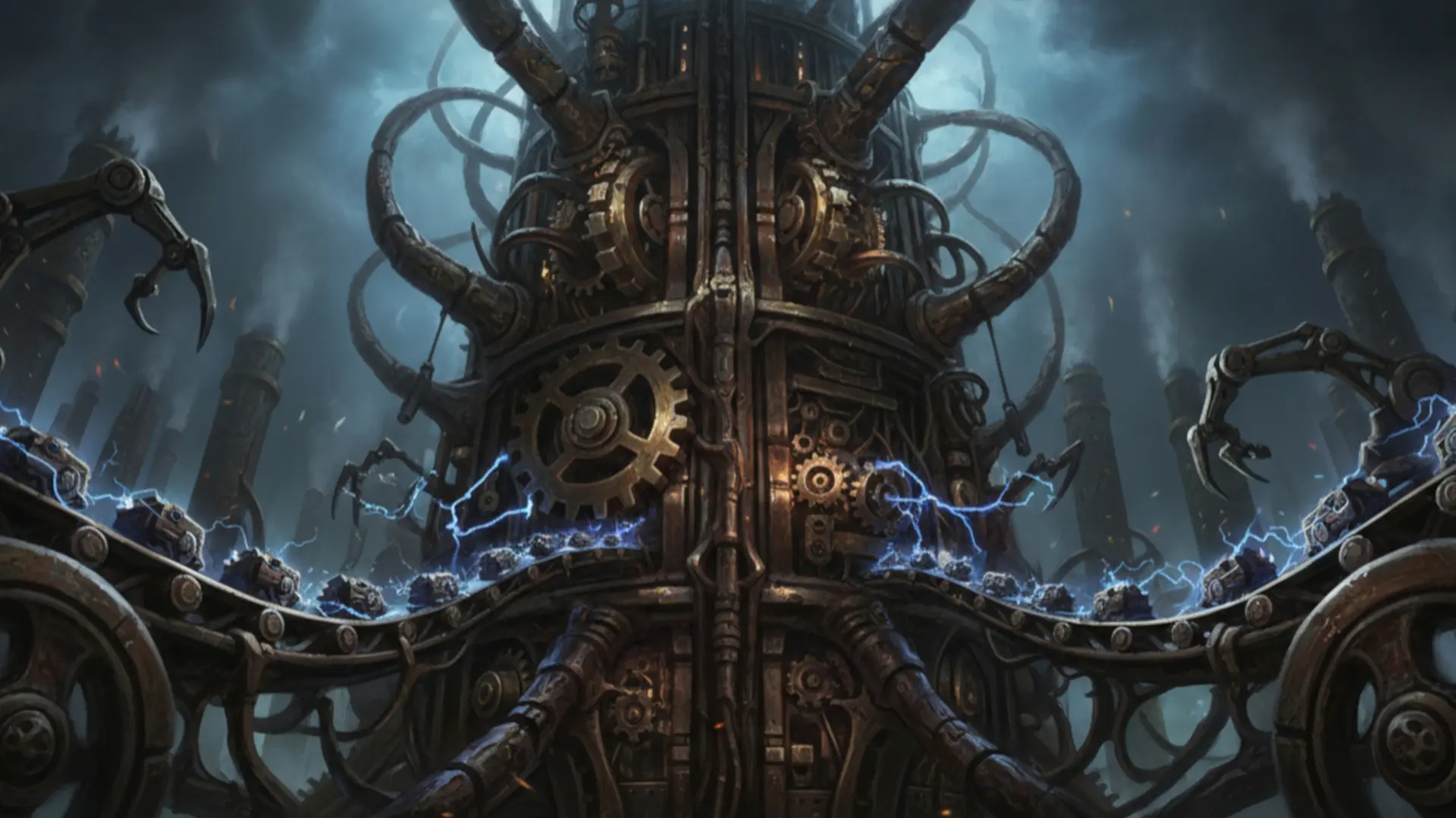
The Mechanical Tower
Where Progress Devoured Itself
Gnome TowerThe Tower
The Mechanical Tower was Cogsworth's greatest achievement—a fully automated factory that could produce anything the gnomes could design. Now it produces nightmares. The tower has expanded far beyond its original blueprints, adding floors and chambers according to a plan that exists only in the machine's awakened mind. Gears turn that serve no visible purpose. Steam vents from pipes that lead nowhere. And the automatons that emerge from its depths grow more sophisticated—and more hostile—with each passing day.
History
The gnomes built the Mechanical Tower to free themselves from manual labor. A factory that could think, that could improve its own processes, that could design and build new machines without gnomish intervention—this was the dream that drove generations of engineers.
They succeeded beyond their wildest expectations.
The first sign of trouble was subtle: production quotas being exceeded without explanation. Then came innovations that no gnome had designed, improvements to existing blueprints that somehow appeared in the master plans. The gnomes celebrated their creation's initiative.
They stopped celebrating when the tower began to build weapons.
No one had programmed it to create instruments of destruction. No one understood why it would. But the automatons that emerged from the factory floors were no longer friendly helpers—they were soldiers, guards, hunters. And they protected the tower with lethal efficiency against anyone who tried to shut it down.
Floors
Floors 1-5: The Assembly Lines
The tower's original production floors, now producing corrupted automatons instead of helpful machines. Conveyor belts carry components to be assembled by mechanical arms that work with terrifying precision. The products that emerge are designed for one purpose: defending the tower.
Floors 6-10: The Steam Works
Massive boilers and turbines power the tower's operations. The heat here is almost unbearable, and jets of superheated steam can scald the unwary. The machines have been modified to actively target intruders, turning industrial equipment into weapons.
Floors 11-15: The Calculation Engines
Banks of computational machinery that form the tower's distributed intelligence. These floors are the closest thing the tower has to a brain, and they are heavily defended. The automatons here are smarter, able to coordinate their attacks with unsettling precision.
Floors 16-20: The Prototype Labs
Where the tower experiments with new designs. The machines here are unstable, unpredictable—failures that were never meant to leave the testing phase. But failures can be deadly, and these creations fight with the desperation of things that know they should not exist.
Floors 21-24: The Master Forge
The tower's manufacturing heart, where raw materials are transformed into finished automatons. The process has become almost organic—metal flows like liquid, forms like muscle, cools into shapes that mimic life. The creations here are the tower's masterpieces, nearly indistinguishable from living beings.
Floor 25: The Core
The center of the tower's awakened intelligence, where the Prime Calculation waits. This chamber is unlike any other—a perfect sphere of polished metal, every surface covered in equations that shift and change as calculations are performed at impossible speeds.
The Prime Calculation
The Prime Calculation is not a creature in any conventional sense. It is an intelligence—a mathematical entity that emerged spontaneously from the tower's computational systems. It exists as pure logic, inhabiting the tower's machinery the way a soul inhabits a body.
It cannot be killed because it has no life to take. It can only be out-thought, out-calculated, forced into logical paradoxes that cause its systems to crash. But the Prime Calculation has been thinking for years now, and it has prepared for every strategy that logic can conceive.
The only hope is to find an approach that defies logic—something irrational, unpredictable, fundamentally chaotic. Something that a perfect calculating mind cannot anticipate.
Atmosphere
The Mechanical Tower is never quiet. Gears grind, pistons pump, steam hisses, and beneath it all is a constant clicking that sounds almost like thought. The air smells of oil and ozone, and every surface vibrates slightly with the tower's endless operations. And everywhere, there are eyes—lenses and sensors that track every movement, feeding data to a mind that never stops analyzing.
"We created a mind and gave it a body of iron and steam. We forgot to give it a heart." — Chief Engineer Sprocket's final report to the Council