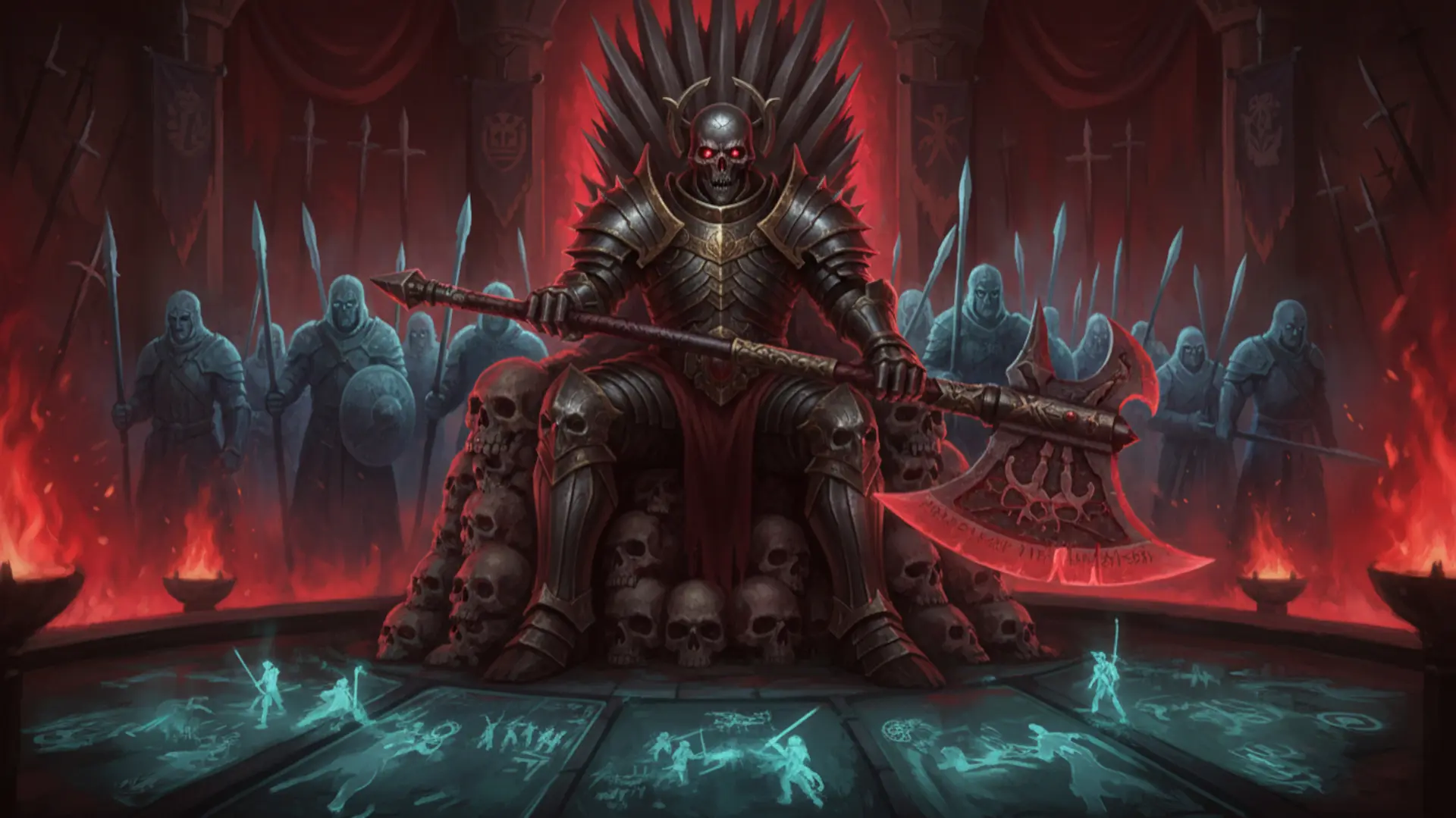
The Ancestor King
Lord of the Risen Dead
The Beast-Skull TowerThe Ancestor King
He has many names in orcish legend: Gorthak the Undefeated, the First Warchief, the Blood-Drinker, He Who United the Clans. In life, he forged the orcish nation from warring tribes. In death, he was supposed to lead the honored ancestors in eternal battle beyond the mortal realm.
Instead, he leads them here, against his own descendants, furious at a betrayal centuries in the making.
Origins
Gorthak lived in the age of legends, when the orcish clans warred constantly against each other and against the world. Through strength, cunning, and a ferocity that terrified even other orcs, he conquered every rival clan and forged them into a single nation. He established the honor code that orcs follow to this day. He chose Skullgar as the proving ground where future warriors would earn glory.
When Gorthak finally fell in battle—the only acceptable death for a warchief—the shamans performed the sacred ritual to send him to the eternal battlefield beyond death. But the ritual was incomplete. Some crucial element was missing, lost to time and carelessness.
Gorthak remained in Skullgar, buried beneath the skull-adorned tower built in his honor. He could feel the other honored dead joining him, generation after generation, all trapped in the same incomplete afterlife. He waited for the living to remember the ritual. He waited for release.
He has been waiting for three thousand years. He is done waiting.
The Rising
The Ancestor King did not intend to wage war against his descendants. For millennia, he simply waited, growing stronger as more honored dead joined him, trusting that the living would eventually remember their duty.
But orcish memory is short, and the ritual was complex. Details were lost. Steps were forgotten. What remained was ceremony without substance—rites performed without understanding, honoring the dead without actually releasing them.
When the last shaman who knew the true ritual died without passing on the knowledge, something in Gorthak broke. His patience, legendary even in life, finally reached its end. If the living would not release the dead willingly, the dead would take what was owed.
The first spirits rose at midnight, warriors who had died centuries ago emerging from soil soaked with ancient blood. The living orcs fought them—what else could orcs do?—but found themselves facing their own ancestors, wielding techniques they had taught their descendants.
Gorthak himself emerged last, still wearing the armor he died in, still carrying the axe that had united the clans. He issued a single demand: perform the true ritual, or watch your entire race join the army of the dead.
Nature
The Ancestor King is not a mindless undead horror. He is exactly what he was in life: a brilliant tactical mind, an overwhelming physical presence, and a will that cannot be broken. Death has not diminished him. If anything, centuries of trapped rage have made him more dangerous.
He commands the risen dead not through magic but through the same force of personality that united the living clans. The honored ancestors follow him because he earned their loyalty in life and has kept it in death. They share his grievance, his fury, and his determination.
But beneath the rage, Gorthak remains an orc of honor. He does not wish to destroy his people—he wishes to be free of the mortal realm. If the living could perform the true ritual, he would lead his army into the afterlife without hesitation. His war is not about conquest. It is about release.
Powers
The Ancestor King's abilities combine legendary martial prowess with death's gifts:
Ancestral Authority: Gorthak commands every risen orc in Skullgar. His orders are absolute—the honored dead obey him as they did in life, perhaps more so. This army numbers in the thousands and grows with every orc who dies in the fighting.
Undying Endurance: Gorthak cannot be killed by conventional means. Wounds that would destroy a living orc merely slow him. He can be defeated, driven back, even temporarily destroyed—but he reforms within the tower, ready to fight again.
Legendary Combat: In life, Gorthak was the greatest warrior the orcish race ever produced. Death has not dulled his skills. He fights with three thousand years of accumulated technique, having watched every battle fought in Skullgar from beyond death.
Spirit Calling: Gorthak can summon specific ancestors to fight beside him. Need a legendary archer? He calls one. Need a squad of berserkers? They emerge from the earth. His army contains every great warrior in orcish history.
Defeating the Ancestor King
Gorthak cannot be permanently destroyed through combat. He is tied to Skullgar itself, to the blood-soaked ground and the accumulated honor of countless generations. As long as the land remembers the orcish dead, he will rise again.
The only true solution is the one Gorthak himself demands: completing the ritual that should have been performed three thousand years ago. The shamans have been desperately researching, trying to reconstruct what was lost. They have pieces—fragments preserved in old songs, hints in ancient carvings—but the complete ritual remains elusive.
Some fragments suggest the ritual requires a living sacrifice: a warchief who willingly joins the ancestors to lead them onward. Others hint at sacred artifacts that must be recovered. Still others speak of words of power that must be spoken in the original orcish tongue, long since evolved beyond recognition.
Finding these answers means braving the Beast-Skull Tower, where Gorthak's army grows stronger with each fallen challenger.
The Throne of Skulls
The peak of the Beast-Skull Tower is dominated by a massive throne constructed from the skulls of every enemy Gorthak defeated in life. The number is staggering—thousands of skulls arranged in a monument to victory.
Gorthak sits upon this throne when not actively fighting, surrounded by his greatest champions. The chamber reeks of old blood and older death. The walls are adorned with weapons and banners taken from defeated foes across three millennia.
Here, the veil between life and death is thinnest. The honored dead wander freely, reenacting their greatest battles for eternity. Warriors who died centuries ago duel warriors who died yesterday. It is everything the orcish afterlife was supposed to be—except they cannot leave.
Challengers who reach this place face not just Gorthak but the greatest warriors in orcish history, all fighting together, all refusing to stay down. It is the ultimate proving ground—glory beyond measure for those who survive, and a place among the ancestors for those who fall.
"Father stands before me in the form he wore at his death—young, strong, furious. He taught me everything I know about combat. Now I must use it against him. There is no honor in this. There is no dishonor either. There is only the fight." — Warchief Groknar, facing his risen father