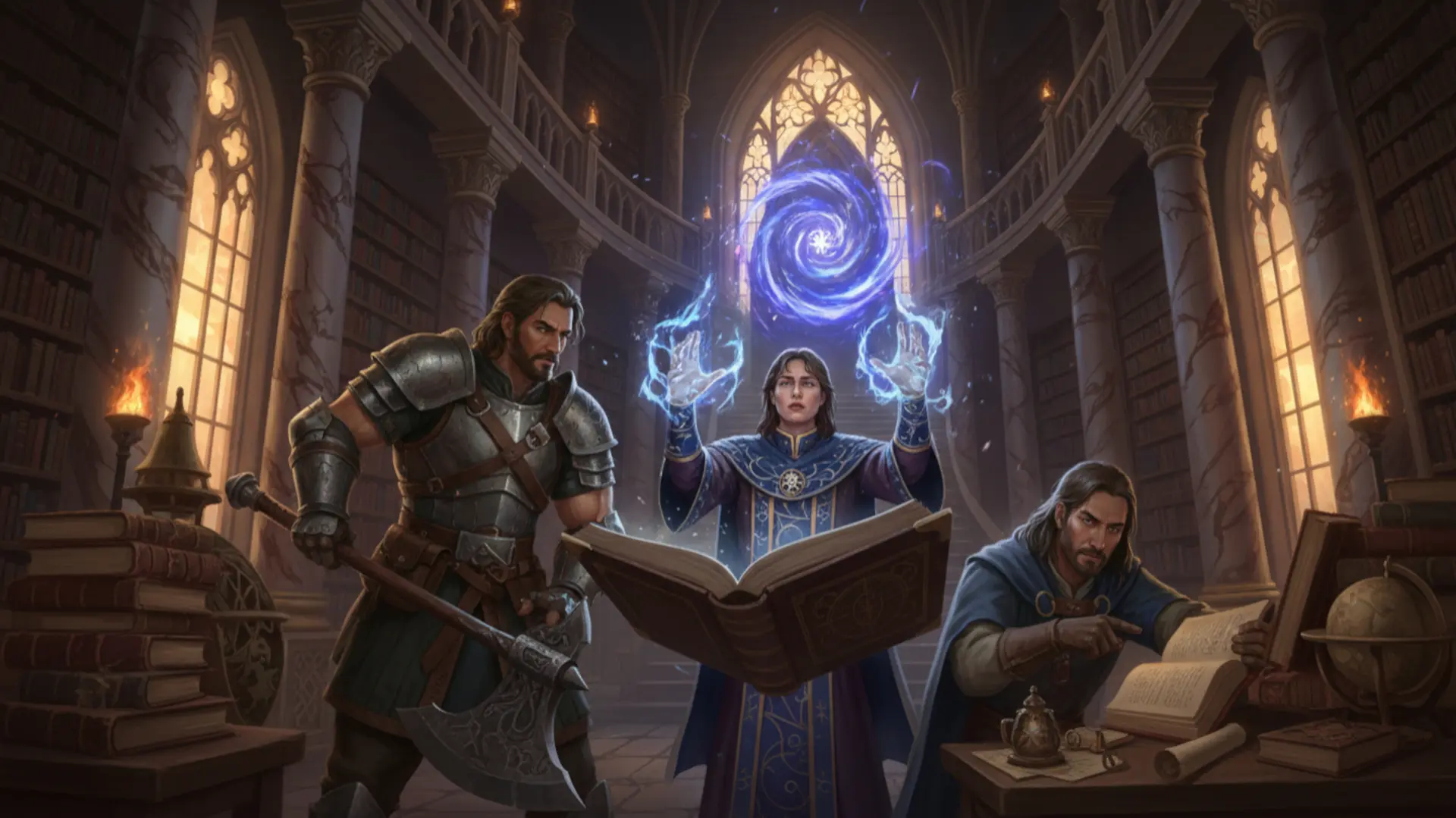
Humans
The Ambitious Seekers
The Human Race
Humans are the youngest of the five great races, yet they have achieved what elder races took millennia to accomplish. Their cities rival the ancient elven groves, their forges match dwarven craft, and their magical academies have unlocked secrets that other races feared to pursue.
This ambition is both their greatest strength and their most dangerous flaw.
Origins
The histories speak of humans emerging from the eastern plains, nomadic tribes following the herds and the seasons. While elves tended their eternal forests and dwarves carved their mountain homes, humans wandered—learning, adapting, growing.
Their first great cities rose along the rivers, built from mud and wood before they learned stone. They watched the other races and learned: metallurgy from dwarves who traded for grain, agriculture from elves who pitied their short lives, engineering from gnomes who found their persistence amusing.
But humans were not content to merely copy. They combined these teachings, improved upon them, and created something new. Within a few generations, human cities had grown to rival any in the world.
Culture
Human society values achievement above all else. Where elves measure worth in wisdom and dwarves in honor, humans ask a simple question: what have you accomplished?
This drive creates a society of constant motion. Merchants seek new trade routes. Scholars pursue forgotten knowledge. Warriors train for glory. Everyone strives to leave their mark on history, knowing their time is brief compared to the elder races.
The Guilds
Human cities organize around powerful guilds—the Merchants' Consortium, the Mages' Circle, the Knights' Order, the Artisans' Brotherhood. These institutions provide structure and opportunity, channeling human ambition into productive ends.
Guild membership is earned through merit and achievement. A peasant's child who shows magical talent can rise to lead the Mages' Circle. A merchant's son who proves himself in battle can join the Knights' Order. This social mobility drives humans to excel.
Magic and Learning
Humans approach magic with the same ambitious methodology they apply to everything. Where elves commune with natural forces and dwarves bind magic into runes, humans dissect, categorize, and systematize.
The great academies of Ironhaven have produced more magical innovations in three centuries than elves discovered in three thousand years. They have also produced more magical disasters—a fact the humans prefer not to discuss.
Strengths
Adaptability: Humans thrive in any environment and excel at learning new skills. A human raised among dwarves will mine like a dwarf. One raised among elves will shoot like an elf. This flexibility makes them formidable allies and dangerous enemies.
Ambition: Where other races might accept their lot, humans always reach for more. This drive has built empires, unlocked magical secrets, and pushed the boundaries of what mortals can achieve.
Unity in Diversity: Human kingdoms unite diverse peoples under common cause. Their cities welcome all races, their armies field soldiers of every background. This inclusivity makes them natural leaders of coalitions.
Weaknesses
Impatience: Humans want results now, not in a century. This urgency leads to shortcuts, half-tested theories, and consequences that unfold only after the original actors are dead.
Hubris: Success breeds confidence, and confidence breeds overreach. The Arcane Spire stands as monument to human achievement—and warning of what happens when humans believe they can master anything.
Short Memory: A human generation is barely a moment to an elf or dwarf. Lessons learned by grandfathers are forgotten by grandchildren. Warnings go unheeded because the disasters they reference have passed from living memory.
The Blight and Humanity
The corruption of the Arcane Spire strikes at the heart of human identity. Their greatest magical achievement has become their greatest shame. The tower that was meant to prove human superiority now threatens to destroy them.
Some humans have responded with characteristic determination, throwing resources into finding a cure. Others have fallen into despair, seeing the Blight as punishment for their ambition. A few whisper that perhaps the elder races were right to fear certain knowledge—a thought that would have been heresy a generation ago.
"We reach for the stars because we cannot accept the ground beneath our feet. Sometimes we grasp glory. Sometimes we fall. But we never stop reaching." — Alaric the Wise, founder of Ironhaven