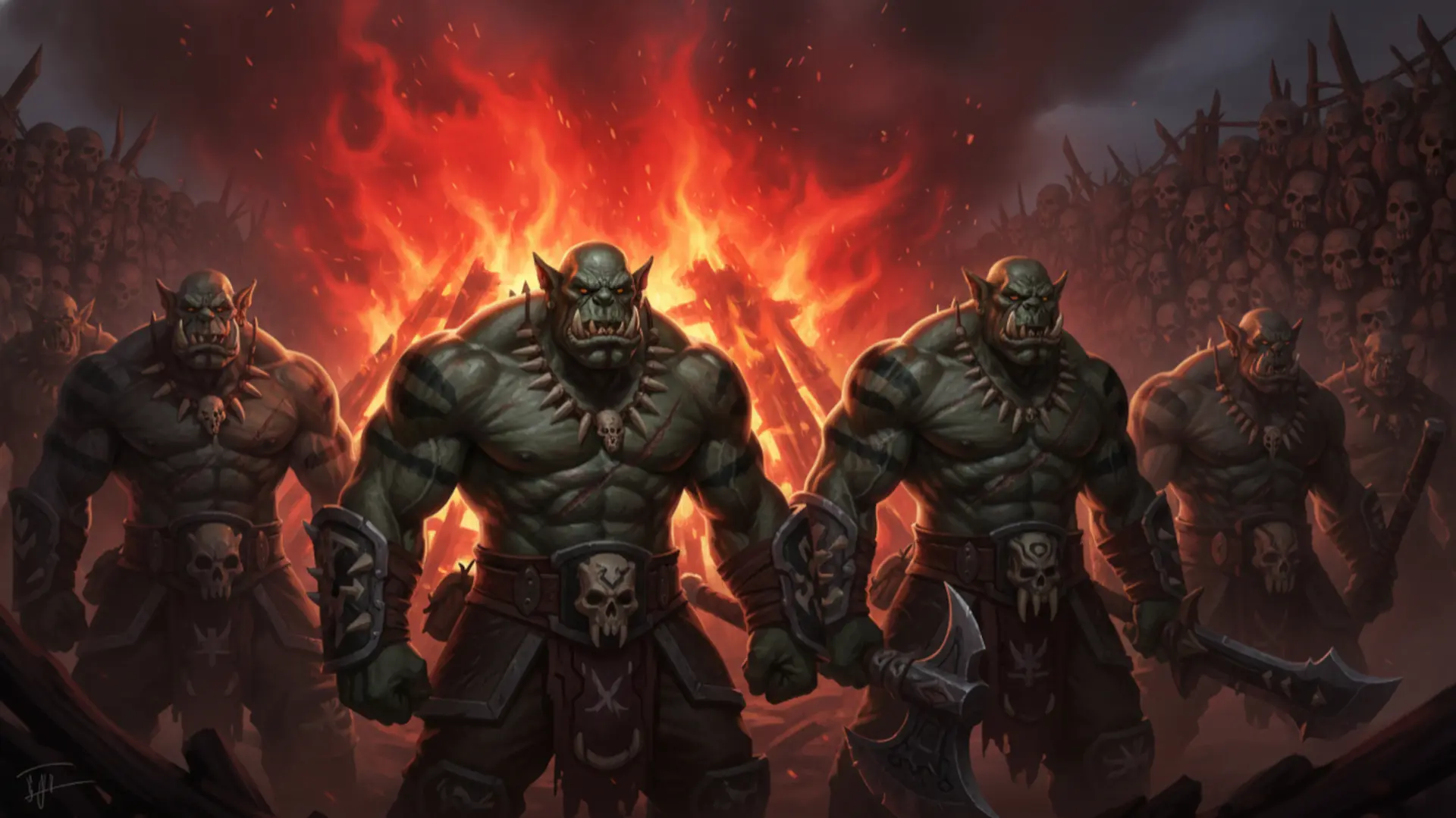
Orcs
The Eternal Warriors
The Orcish Race
Orcs are warriors born. Their society, their religion, their very identity revolves around combat. Other races see this as barbarism. Orcs see it as truth—the honest acknowledgment that the world is struggle, and only the strong survive.
They have always been strong. They are now learning that some battles require more than strength.
Origins
Orcish creation myths speak of a first battle—a primordial conflict from which the orcish race emerged victorious. The enemy has been forgotten, the cause has been lost to time, but the victory remains central to orcish identity. They are the descendants of winners, carrying the blood of those who triumphed when existence itself was at stake.
The First Battle also created Skullgar—or so the myths claim. The ground there is soaked with blood so ancient it has become part of the earth. The spirits of fallen warriors linger, too proud to move on, too honored to be forgotten. For generations, orcs have returned there to train, to fight, and to die gloriously.
They never expected the dead to start fighting back.
Culture
Orcish society is simple in principle and complex in practice. The strong lead. The weak follow. Disputes are settled through combat. These rules seem brutal to outsiders, but they create a society with absolute clarity about hierarchy and expectation.
The Clans
Orcs organize into clans based on lineage and battle-bonds. A clan is family, army, and community combined. Clan members fight together, feast together, and die together. Betraying one's clan is the ultimate dishonor—worse than death, for death in battle brings glory while betrayal brings eternal shame.
The major clans of Skullgar have feuded for generations, but they unite against external threats. The Rising has forced unprecedented cooperation, with ancient rivals fighting side by side against the dead.
The Honor Code
Orcish honor is not human honor. Mercy is weakness. Retreat is cowardice. A warrior's worth is measured in victories, scars, and enemies slain. This code seems savage to other races, but it creates warriors of unmatched ferocity and loyalty.
An orc who breaks the honor code becomes clanless—cast out from society, denied the warrior's afterlife, forgotten by history. This fate is so terrible that most orcs would literally rather die than face it.
The Shamans
Not all orcs are warriors. The shamans serve as spiritual guides, interpreting omens, communing with ancestral spirits, and performing the rituals that ensure honored dead reach the eternal battlefield.
Since the Rising, shamans have taken on new importance. They are the ones who understand—or try to understand—why the ancestors have turned hostile. Their efforts to communicate with the angry dead have met with limited success and considerable danger.
Strengths
Strength: Orcs are physically powerful, able to wield weapons that other races can barely lift. In direct combat, few can match orcish might.
Courage: Orcs do not fear death—they welcome it, if it comes in glorious battle. This fearlessness makes them terrifying enemies and steadfast allies.
Unity: When clans unite, orcs become an unstoppable horde. Their ability to set aside differences for common cause has decided more than one war.
Weaknesses
Inflexibility: The honor code that gives orcs strength also limits them. Strategies that require retreat, deception, or patience are difficult for orcs to accept, even when necessary.
Aggression: Orcs solve problems through violence. When violence doesn't work, they apply more violence. This approach fails against enemies that cannot be killed.
Pride: Orcs would rather die than admit weakness. This pride prevents them from seeking help, even when help is desperately needed.
The Rising
The honored dead were supposed to strengthen the living—to provide guidance, blessing, and inspiration. Instead, they rose from their tombs with ancient weapons in hand and murder in their empty eyes.
The shamans believe they understand why. The ancestors were promised release—a ritual that would send them to the eternal war that awaits beyond death. But generations passed, and the ritual was forgotten. The dead remained trapped, watching as new warriors joined them in imprisonment.
The Rising is not an invasion. It is a prison break. The ancestors want out, and they will kill every living orc to get it—or to punish those who forgot to free them.
The living orcs face an impossible choice. If the shamans can reconstruct the ritual, the ancestors might be appeased—but performing it might require sacrifices the living are not prepared to make. If the ritual cannot be found, the war with the dead will continue until one side is extinct.
Either way, orcs face a battle unlike any in their history—one that cannot be won through strength alone.
"My father's father's father stands before me with sword raised. He taught my family to fight. Now I must fight him. The honor code has no answer for this." — Warchief Groktar, before the Battle of the Bone Gate